
Pulperbacks #0
The Deep Blue Hello

Dear reader,
I come by my love of pulp fiction honestly. I am named after one of detective fiction’s most famous non-detective protagonists. My parents had chosen the name Mike for me—no, not after Mike Hammer, neither is a fan of Spillane—but when my slightly older cousin beat me to the Mike-name punch, they had to come up with a new idea. My parents were poor at the time, my dad a graduate student at Caltech, and my mom supported them both by working in the library there in Pasadena. One of the few joys they could afford was purchasing and reading cheap used books. While they loved some of the same authors and series, one stood out. So they named me Travis, after Travis McGee, the protagonist of 21 novels by pulp mystery titan John D. MacDonald.
So I name my first post here at Pulperbacks after the first entry in the Travis McGee series, The Deep Blue Good-by. It’s not only the first book in a series my parents love—it was also my introduction to real honest-to-God pulpy genre fiction. I decided I had to read it since I was named for its main character. Luckily for me and my name, it’s great.
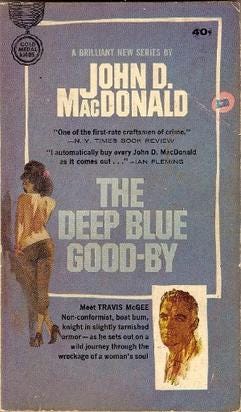
How could it not be with a cover like that (the work of Ron Lesser, a pop artist with tens if not hundreds of cover credits, and likely many more he never received any credit or money for)? It’s got everything you want from a retro paperback like this—scantily clad dame positioned on just this side of the obscenity laws of the time, square-jawed hero (my namesake down in the corner), gripping read-this-now cover blurb.
The complete particulars of the plot don’t matter. The Deep Blue Good-by sets the template for the McGee series and embodies what makes this era of mystery/detective fiction/noir great. Yeah, McGee isn’t a private detective, but he functions like one in the story—he bills himself as a “salvage consultant,” which means he helps people get their stolen property or money back. His fee? He keeps half—well, at least he says he does, though, for the most part, his moral compass prevents him from doing so. Because while he portrays himself to the world as a beach bum “taking his retirement in installments,” he’s really a modern knight-errant righting the world’s wrongs where he can and usually bedding a few damsels along the way. In the case of this first book, the wrong that needs writing is one of detective fiction’s most terrifying villains, Junior Allen, a man who uses psychological terror to torture and manipulate the women he brings into his orbit—for no other reason, really, than the fact that he can.
Let’s get this out of the way right at the beginning—the McGee books, like the majority of detective novels of the pulp era (roughly 1930-1970, give or take a few years in either direction), are pretty dated in terms of their sexual politics. Though The Deep Blue Good-by was published in 1964, it takes place in a post-WWII, pre-Vietnam world of masculine manly white men. Women in these stories are damsels in distress, wounded dove abuse victims, or femme fatales turned evil by the petty weakness of “the weaker sex.” In The Deep Blue Good-by and other installments, all these wounded doves need to heal is a roll in the hay with the handsome and worldly McGee, whose magical sex powers can wash away any trauma and even occasionally turn those evil, petty, weak, villainous women into societally appropriate good girls again.
But John D. MacDonald, for all the regressive sex and gender stuff—and occasionally race stuff, though it seems he was more just a man ignorant of his own privilege at the time rather than virulently racist by any means—was also very forward-thinking for an author of his time, especially one who specialized in taut, intricate, violent, sexy mystery stories. There is a class consciousness and a frankness about the world’s injustice often absent from other hard-boiled stuff, which leaned into anti-commie Cold War paranoia more often than not. His environmentalism was radical for its time. The natural beauty of the Florida he wrote about and that Travis McGee called home was being quickly destroyed by the greed of sheer unfettered capitalism, which he railed against in many a book.
And that’s one of the things I love about genre fiction—it often handles the “big issues” better than literary fiction because instead of hammering the reader over the head with a lecture or a message, it seamlessly weaves its commentary into a story where the villain might, say, get thrown off the back of a speeding boat and impaled by the trailing anchor. And really deserve it.
I never really intended to start collecting retro paperbacks, not even after reading and loving The Deep Blue Good-by. But one trip with my reading-loving family to Montana brought me to Missoula’s Book Exchange, which may be the best bookstore in the world, and if not that, it’s at least the best organized. I found myself poking through used books and picking out old paperbacks attracted by author names I knew—Chandler, Hammett, Spillane, Lawrence Block—and those striking hand-painted covers. It became an addiction, a healthier one than the alcohol I gave up almost ten years ago now.
And that’s what Pulperbacks is all about. I want to share these books, their covers, their stories with you. Not just mysteries, but sci-fi, fantasy, gothic fiction, spy novels, and the occasional piece of good old-fashioned smut. Some of these books, like The Deep Blue Good-by, are great. Many are not. Some include deep social commentary or allegory weaved intricately into their fast-moving stories. Others are just mean, nasty fun. I hope you enjoy reading about them as much as I enjoy talking about them.
xoxo
Travis
PS - Please subscribe to get this bad boy in your email inbox if you’re interested. Many Substacks charge for subscriptions, but Pulperbacks is free, gratis, and also available for no charge.
PPS - Pulperbacks will begin in earnest with my next entry, Pulperbacks #1, coming soon. I’ll review the first Lew Archer novel, The Moving Target, by Ross Macdonald (no relation to John D).