
Pulperbacks #1
The Moving Target by Ross Macdonald

The Details
The Moving Target by Ross Macdonald
Lew Archer #1
First edition published 1949
My copy published 1979 (Bantam U.S. edition)
Cover art by Mitchell Hooks
184 pgs
The Author
Ross Macdonald was the main pen name of Kenneth Millar (1915-1983) and Lew Archer was his most famed creation. A Los Angeles private investigator in the laconic Philip Marlowe mold, Archer starred in 18 novels and around a dozen short stories, many of which take place not only in the very real and realistic Los Angeles of the 1940s, 50s, 60s, and 70s but the fictional Santa Teresa, a stand-in for the Santa Barbara Macdonald/Millar called home for much of his life.
I’ve often come across Archer novels in my hunts through the paperbacks at used bookstores but always shied away because I could never find the one I knew came first in the series, and sometimes I get it in my mind with a series I need to start at the beginning, as I did with Travis McGee and The Deep Blue Good-by. I finally came across this semi-vintage copy of The Moving Target, the first Archer novel, recently and decided it was time to dive in.
The Book
In the Chandler/Marlowe mold, The Moving Target is definitely a Southern California novel. Our antihero detective Archer details his worldview in clean and clever first-person narration, his voice a mix of cynicism and ironic humor. He wants to see himself as a fish out of water among the California rich and the Hollywood fakes but manages to fit in seamlessly. His charm is obvious, and it makes sense that the Hollywood Macdonald lampoons chose Paul Newman to play Archer (but for some reason to rename him Harper) in the films based on this novel and its sequel, The Drowning Pool.
In this particular entry, Archer is hired by a rich woman to find her missing husband—not because she suspects he’s cheating or that he’s in danger, but because she doesn’t want him to spend all of their money. Mr. Ralph Sampson (not to be confused with the basketball icon, obviously) has a habit of going on benders and giving away large chunks of his oil fortune, often to a quirky assortment of SoCal frauds such as cult leader/con man Claude or aging starlet turned astrology guru Fay Estabrook.
It’s not much of a spoiler to say that there’s more to Sampson’s missing status than a long bender and excessive spending, and Archer encounters petty crooks, Hollywood hangers-on, and the aforementioned cult leader and astrology guru on his way to getting to the bottom of the mystery. There’s also, of course, a beautiful young woman who shows interest in Archer (in between receiving marriage proposals from Archer’s former district attorney pal and chasing a young, dashing man who just happens to be the disappeared Sampson’s pilot).
The mystery gets complicated quickly, shifting from missing person case to kidnapping investigation, leading to a conclusion in which basically every character mentioned throughout the novel plays a part. There are red herrings in this mystery, sure, but they’re not there just to play a role in tricking the reader. They’re there to illustrate that anyone in Los Angeles or the fictional Santa Teresa is trying to get over on someone. Even our hero.
I liked The Moving Target enough that I’ll give more Archer a try, but not enough for it to be a favorite. The mystery itself had one too many twists for my taste. Even at 184 pages, it felt like one or two potential side plots could have used an editor’s exacting eye. But the lead character is one I’ll happily follow through another twisty mystery because his philosophical asides about himself and his own shortcomings and those of the people and the world around him kept me fully engaged.
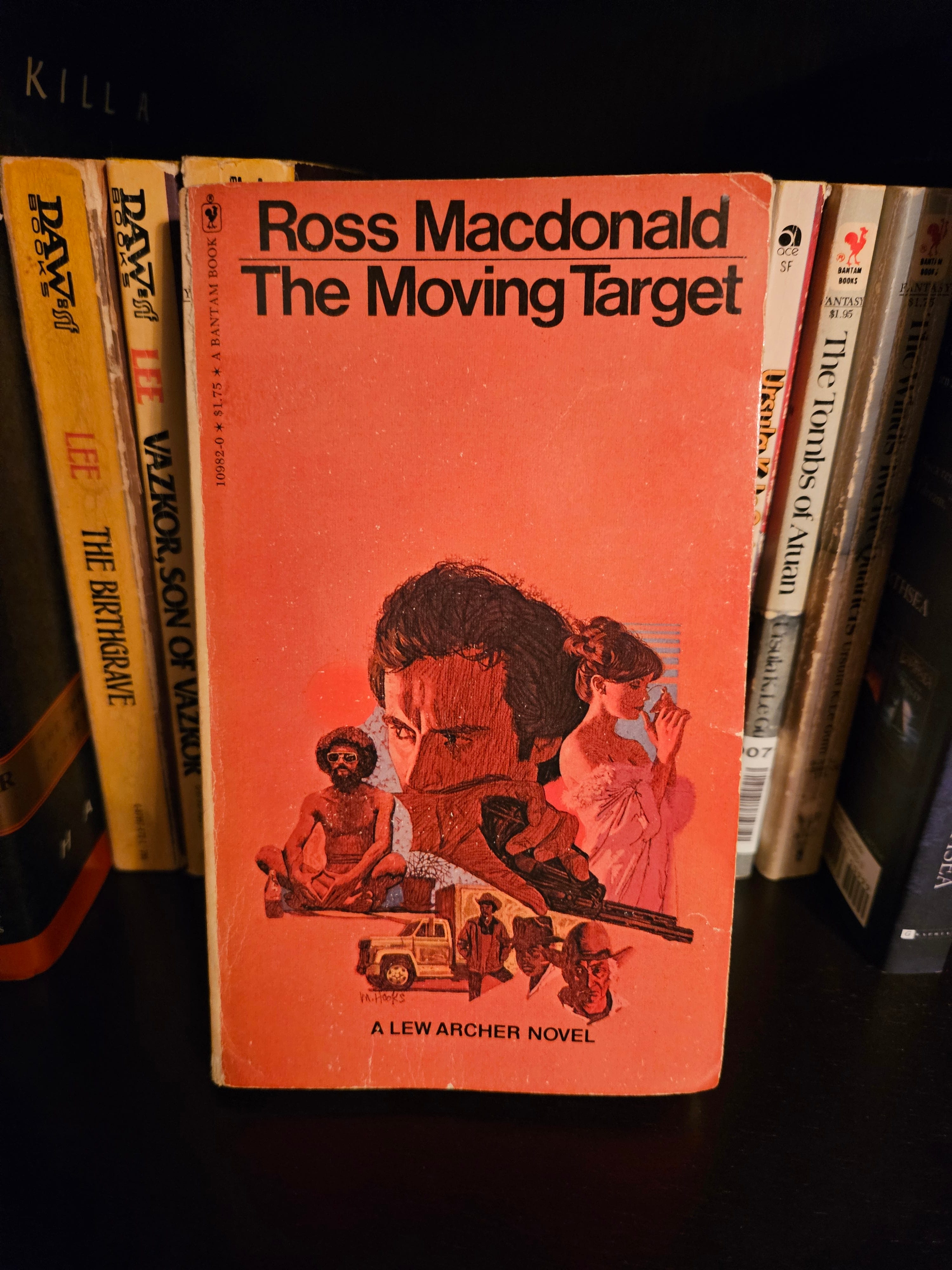
The Cover
The cover painting for the 1979 Bantam (U.S) edition has the feel of a movie poster, complete with pistol-toting hero, bare-shouldered beauty, and a few potential villains. The art is the creation of Mitchell Hooks (1923-2013), an American artist and illustrator known for his pulp magazine and paperback cover work. He also painted the original movie poster for Dr. No, creating the iconic image of Sean Connery as James Bond.